
So what is trust, exactly?
By Zoran Hristov ·
This is part two of a weekend essay. Part one, Who is your best assistant?, asks who in your working life has only one stake: you getting better.
In The Odyssey, the young Telemachus takes advice from two old friends of his father’s: stop waiting, go and find out for yourself. Both times, it’s really the goddess Athena wearing a face he already trusts. She chose familiar faces for a reason: advice only lands when it comes from someone you believe is on your side.
A coach is only useful if you let them see you. When the surgeon Atul Gawande noticed his results had stopped improving, he asked a retired professor to watch him operate, and came away with a whole page of notes and a better complication rate a year later. He was honest about what it cost: “It was painful. I didn’t like being observed.”
In a career, being observed means something similar. You have to tell your coach the thing you haven’t said out loud to anyone: that you’re bored, or scared, or that you don’t actually want the promotion everyone expects you to chase.
That takes trust, and trust is a more precise thing than it sounds.
The coach Charles Feltman offers the clearest definition I’ve found: trust is “choosing to risk making something you value vulnerable to another person’s actions.” Not a feeling, a choice. And the thing you make vulnerable, when you open up about your career, is a lot: your reputation, your income, your sense of who you are.
So how does anyone earn that? Two ideas help.
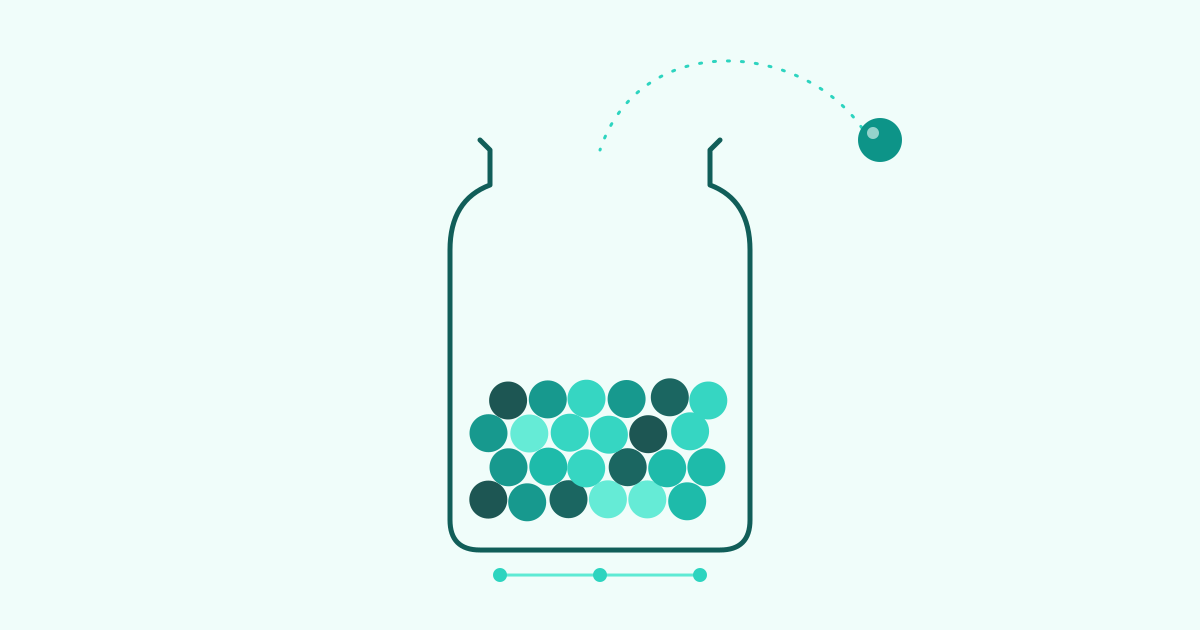
Trust is a marble jar. The researcher Brené Brown tells a story about her daughter, hurt after friends broke a confidence. Brown explained trust with the marble jar from her daughter’s classroom, where marbles go in for good behaviour and come out for bad. You share your hard stories, she said, with the friends who, over time, have filled up their marble jar. Her conclusion is the most useful sentence in this whole essay: “Trust is built in very small moments.” Not grand gestures. A remembered detail. A promise kept. A confidence held.
One of those small moments has a name in Brown’s framework: the vault. “What I share with you, you will hold in confidence.” It sounds obvious. In a working life it is rare, and it is the first marble any coach has to earn.
Trust stands on three legs. Frances Frei, a Harvard Business School professor who was brought in to help rebuild trust at Uber, describes it as a triangle. People tend to trust you, she and Anne Morriss write, “when they believe they are interacting with the real you (authenticity), when they have faith in your judgment and competence (logic), and when they feel that you care about them (empathy).” When one leg is short, trust wobbles. In her experience the most common wobble is empathy: being so busy being right that the other person doesn’t feel heard.
Put those together and you have a working test for anyone who wants to help you with your career. Are they real with you? Does their thinking hold up? Do they care about you, not just the problem? And do they keep the vault?
How to build trust with your coach
Here’s the uncomfortable part: trust runs in both directions. Your coach has to earn it, but you have to let them. Some practical ways to do both:
- Start with a small, true question. Don’t open with your biggest dilemma. Bring something real but low-stakes, like a tricky conversation next week or a decision you keep postponing, and see how it’s handled. That is the first marble.
- Check the vault before you need it. Ask plainly: who sees what I say? Where does it go? With a human coach, that’s a confidentiality conversation. With an AI coach it matters even more: ask whether a person reviews your conversations, where they are processed, and whether they are sent to an outside AI provider. A coach who can’t answer that clearly hasn’t earned your harder stories yet.
- Watch for the push-back. A coach who agrees with everything is a mirror, not a coach. The logic leg of trust shows up when they question your framing, with reasons, and you come away seeing something you didn’t. If it feels a little like Gawande being watched, that is usually a good sign.
- Notice whether they remember. Empathy at work looks less like warmth and more like attention: they recall what you said last time, and they ask how the thing you were dreading actually went.
- Tell the unflattering version. Your coach can only work with the reality you bring. “I didn’t like being observed” is the price of getting better, and the people who improve fastest are the ones who pay it early.
- Work on one thing at a time. Big career reinventions rarely survive contact with a Monday morning. Agree on one small habit, try it for a week, and come back to say what happened. Every round trip is a marble in the jar, for both of you.
Trust built this way doesn’t feel dramatic. It feels like the third or fourth conversation, when you notice you’ve stopped performing and started thinking out loud.
Can you trust an AI coach?
This is a fair question, and I’d rather answer it honestly than cleverly.
An AI coach can’t do what Athena did. It can’t borrow a face you already trust, and it shouldn’t try. It has to earn trust the slow way, marble by marble, like anyone else. And it should be open about what it is.
What it can do is be the one advisor in your life whose only stake is you. It has no headcount to protect, no fear of losing you, no need to be liked. It is there at 7 a.m. before the meeting you’re dreading and at 11 p.m. after it. It asks the next question instead of handing you an answer. And if it’s built well, it holds the vault.
That last part is not automatic. It’s a design decision, and it’s the one we cared about most when we built Pathfinder. Some people want their career conversations, the doubts and half-formed plans, kept inside a system built only for that. That’s why our Private coach runs in our own EU-hosted environment, and why choosing it is up to you. Your coach knows your Scorecard results and your background, so you don’t start from zero every time. And it works the way the list above suggests: one habit at a time, with the push-back included.
Whether it earns your trust is not up to me. That’s rather the point.
Frequently asked questions
How long does it take to trust a coach? Usually a few conversations rather than a few months. Trust is built in small moments: a confidence kept, a detail remembered, a useful challenge. Start with a small, real question and see how it is handled before you bring the big ones.
Can you trust an AI career coach? You can trust one that earns it, the same way you would a person. Ask who can see your conversations, where they are processed, and whether they go to an outside AI provider. Then judge it on whether it pushes back with good reasons, remembers what matters to you, and helps you act, not just talk.
Start with a small, true question
If you want to try this with Pathfinder, the easiest first marble is the Collaboration Scorecard. It’s free, you can fill it in before creating an account, and it gives your coach something far more useful to work with than a job title. Then bring it the question you’ve been carrying around all week.
Telemachus didn’t need a goddess. He needed someone on his side who would tell him to go. The voyage was his.
Have a good weekend.
— Zoran
— Zoran
Sources: Brené Brown — “The Anatomy of Trust”, SuperSoul Sessions 2015 (transcript via James Clear); Frances Frei — “How to build (and rebuild) trust”, TED 2018; Frances X. Frei and Anne Morriss, “Begin with Trust”, Harvard Business Review, May–June 2020; Charles Feltman, The Thin Book of Trust; Atul Gawande — “Want to get great at something? Get a coach”, TED 2017; Homer, The Odyssey, books 1–2.