
The career ladder is losing its bottom rung
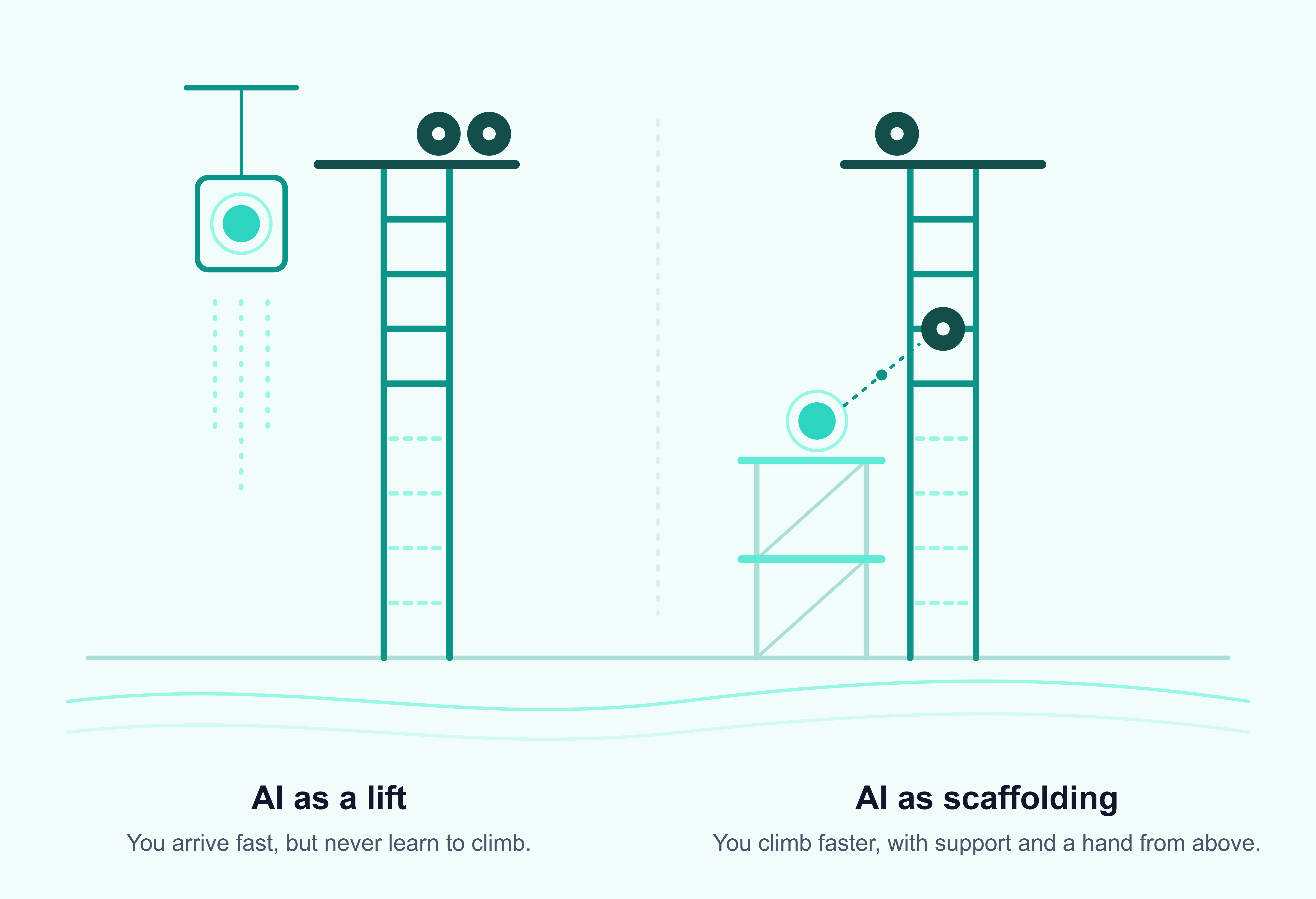
The career ladder is losing its bottom rungs
AI is not emptying offices. In many companies it is reducing the number of entry-level jobs, and many companies have not yet considered what that means for their future workforce.
Many IT managers tell me the same thing: the team is more productive, the backlog is moving, and they are hiring fewer juniors. Few of them have asked the next question. If nobody starts at the bottom today, who is your senior architect in 2035?
This post separates what we know from what we expect. The facts are clear enough to act on. The speculation is labelled as such. Some of it is likely enough to act on now.
What we know
The change is not happening through layoffs. It is happening through hiring. Companies keep their experienced people and hire fewer new ones.
| What we see | Evidence | Where |
|---|---|---|
| No economy-wide job collapse | No discernible disruption 33 months after ChatGPT; occupations shift at pre-existing rates (Yale Budget Lab) | US |
| Fewer young people in AI-exposed jobs | Employment of 22–25-year-olds in the most exposed occupations down 16% relative to others; older colleagues in the same jobs stable or growing (Stanford Digital Economy Lab) | US |
| The same pattern in the Netherlands | Vacancies in GenAI-susceptible jobs almost 25% lower than at end-2022, against under 10% elsewhere; youth employment in those jobs down 13%; in ICT, output up 6.5% while youth employment fell about 11% (Rabobank economists in ESB, via NL Times) | NL |
| And in Ireland | Tech employment for 15–29-year-olds down 20% (2023–2025); for 30–59-year-olds up 12%. “Adjustments have occurred mainly through changes in hiring and entry” (Irish Department of Finance, via Fortune) | IE |
| Entry-level jobs now ask for senior skills | AI-exposed entry roles are 7× more likely to demand senior skills than in 2019 (PwC AI Jobs Barometer 2026) | Global |
| Skills go out of date fast | 39% of current skills outdated by 2030; 59% of workers need reskilling (WEF Future of Jobs 2025) | Global |
Dutch unemployment among 20–25-year-olds rose from 5.7% in 2022 to 7.9% in early 2026, while people aged 30–60 stayed around 2–3% (CBS data, in PwC Nederland).
Caveats. The cause is still disputed. Salomons and Van den Berge argue in ESB that it is not certain GenAI is behind the Dutch decline. A Danish study of 25,000 workers found no difference in headcount or starter share between firms that adopted AI chatbots and firms that did not, though its data stop in mid-2024. Interest rates, the post-pandemic correction and the Dutch pension reform, which makes young workers more expensive, all play a part. Yale also warns of “AI-washing”: layoffs blamed on AI that were coming anyway.
AI is not the only reason starters struggle. But in the US, the Netherlands and Ireland, the youngest workers in AI-exposed jobs have been affected most, while experienced workers have not.
What it means for companies today
These consequences follow from the facts above and are already visible today.
1. Your talent pipeline is shrinking from the bottom. Juniors used to learn the job by doing the simple work: the bug fixes, the test scripts, the first drafts. AI now does much of that work. The learning that came with it does not happen by itself any more.
2. Your seniors carry a heavier load. Someone has to review what AI produces. That falls on experienced staff, on top of their own work. Practitioner reports describe senior burnout from review load, and some companies that swapped seniors for “juniors plus AI” are now rehiring seniors. If you read our post on burnout warnings, you will recognise the pattern.
3. The juniors you do hire are expected to do more from the start. Seniorised entry roles are growing; ordinary ones are shrinking. That raises the bar for starters and the demand on whoever coaches them.
4. Your career paths may be out of date. Most career frameworks assume a ladder: junior, medior, senior, lead. Each step assumes the work of the step below still exists. When that work shrinks, the framework no longer matches how people actually grow.
5. Skills expire faster than job titles. If 39% of skills are outdated by 2030, job descriptions and development plans need regular review. Development becomes ongoing maintenance, not a perk for high performers.
The other side of the coin: AI can shorten the path
There is a serious case that AI makes juniors productive faster, and some companies are hiring more starters because of it.
Cognizant is the clearest example. It has hired about 27,000 graduates worldwide since 2025 and plans to hire 1,500 in the US in 2026, with eight to twelve weeks of training (Newsweek). CEO Ravi Kumar expects company pyramids to become “broader” and “shorter in height”: more starters, fewer layers in between. “Writing software has become relatively easy,” he says, so Cognizant hires for curiosity and problem solving and builds domain knowledge on the job. Its internal data, which has not been independently checked, shows productivity up 37% for its less experienced half of developers and 17% for the more experienced half (WebProNews).
Research supports part of this. In a study of 5,179 customer-support agents, an AI assistant raised productivity by 14% on average and by 34% for novices. Agents with two months’ experience and AI performed as well as agents with more than six months’ experience without it (Brynjolfsson, Li & Raymond). Most of these agents worked in the Philippines, on a fairly scripted task.
Faster output is not the same as faster learning, though. In a trial with 52 mostly junior developers, those who used AI scored 50% on a follow-up quiz, against 67% for those who coded by hand. The biggest gap was in debugging. Developers who asked the AI to explain code or answer conceptual questions scored 65% or more; those who handed the work over scored below 40% (Anthropic). The sample was small, the test was short-term, and the study comes from a company that sells AI tools.
So both things can be true. AI can shorten the path to expertise, or let people skip it. Which one happens depends on how the work is organised: whether juniors use AI to understand or only to produce, and whether someone checks what they have learned. That is a management choice, not a feature of the technology.
This sharpens the point of this post. The risk is not that AI makes juniors unnecessary. It is that companies assume it does, stop hiring them, and miss the faster route that Cognizant is betting on. One caveat from my side: Cognizant sells its people’s time to clients, so cheaper starters with AI also help its margins. Learning is not its only motive.
What we expect
This is my judgement, not measured fact. I have rated each expectation by how likely I think it is, and why.
| Expectation | Likelihood | Why I think so |
|---|---|---|
| A senior shortage in IT around 2030–2035 | High | The juniors not hired in 2023–2026 are the seniors who will be missing later. Experience takes years to build. |
| Senior salaries and poaching rise | High | Fewer people with five to ten years’ experience, more demand for people who can judge AI output. |
| Companies that cut juniors will try to rehire them in two to three years | Likely | There are reports of this with seniors already. Short-term savings often return as recruitment costs. |
| “Apprenticeship” models return under a new name | Likely | Someone has to teach judgement. Structured mentoring, pairing juniors with seniors and AI, becomes a deliberate programme instead of a side effect. |
| Career paths shift from ladders to portfolios | Likely | Progress gets measured in skills and responsibilities gained, not in years and titles. Internal mobility becomes the main way to grow. |
| The pattern spreads beyond IT to sales, marketing, legal and operations | Likely | These are the next most exposed fields in the research. IT is affected first. |
| Mass unemployment from AI by 2030 | Unlikely | Nothing in the data so far points there. Work changes faster than it disappears. |
One more expectation: AI tools will become widely available, so they will not set companies apart for long. The ability to develop beginners into experienced staff will.
What to do about it
You cannot stop the change, but you can decide how your people develop through it. Educate them, or suffer the cost later.
- Count your pipeline. List how many people you have at each level today and how many you will need in five years. If the bottom row is empty, you will have a gap in five years.
- Keep hiring starters, on purpose. Set a fixed share of roles for juniors, even if AI could do part of their work. Treat it as an investment in future seniors, not a cost.
- Rebuild the learning that AI took away. If AI writes the first draft, let the junior review it with a senior and explain why it is right or wrong. Ask juniors to use AI to explain, not only to produce.
- Make mentoring part of the job. Give seniors time for coaching and count it in their goals. Otherwise review work becomes unpaid overtime, which adds to the risk of burnout.
- Redraw career paths around skills. Describe each step by what someone can judge, decide and own, not by years of service. Make sideways moves a normal way to grow.
- Give every employee a personal development plan, and check it twice a year. With skills changing this fast, a yearly review may be too slow. Ask what changed in the role, what the person learned, and what is next.
- Measure retention among your juniors and seniors separately. Losing starters is a warning about your future; losing seniors is a warning about your present.
Questions to act on
For leaders and HR:
- How many juniors did you hire in 2022, and how many this year? What does that gap cost you in 2032?
- Who in your team learns from the work AI now does, and how?
- How many hours a week do your seniors spend reviewing AI output? Is that in anyone’s plan?
- Does your career framework still describe work that exists?
For employees:
- Which part of your job could AI do tomorrow, and what would you do with that time?
- What can you judge today that you could not judge a year ago?
- Who is teaching you, and who are you teaching?
If these questions are uncomfortable, that is a useful place to start. As we wrote in Be a Beginner Again, continued learning is what keeps a career moving.
This is what we built Pathfinder for: personal career coaching for every employee, so development is planned rather than left to chance. For companies with IT teams of 20 or more, it costs €10 per employee per month. The ones that want and need help? We are there for them.
A note on culture: most hard data is American, where hiring and firing are fast. Dutch and Irish data point the same way, but European labour law makes change slower. That buys European companies time. It does not remove the problem.
Sources
- Stanford Digital Economy Lab – Canaries in the Coal Mine (US payroll data)
- Rabobank / ESB on Dutch GenAI-susceptible jobs, via NL Times (NL)
- PwC Nederland – Minder banen voor jongeren (NL; CBS figures, Salomons & Van den Berge, Danish study by Humlum & Vestergaard)
- Irish Department of Finance findings, via Fortune (IE)
- Yale Budget Lab – AI probably not (yet) the reason (US)
- PwC AI Jobs Barometer 2026, via Kelly Services
- WEF Future of Jobs 2025, summary
- ILO – Generative AI and Jobs, 2025
- Newsweek – Cognizant to hire 1,500 US graduates (15 July 2026)
- WebProNews – Cognizant CEO bets on more entry-level hires
- Brynjolfsson, Li & Raymond – Generative AI at Work (NBER / QJE)
- Anthropic – How AI assistance impacts the formation of coding skills (Jan 2026)